


The worst everyday players in baseball
- May 9, 2018
- 4 min read
In any endeavor, there are always people that are worse at something than others. In any endeavor loaded with statistics going back over one hundred years, there are folks that will be demonstrably worse than everybody else. Modern baseball analysts have developed a term known as WAR (wins above replacement) to try and lump offensive and defensive statistics into one catchall number. For an in depth discussion of WAR, click here. In general, the finest players in baseball have a WAR of 8 or higher, with All Stars have a WAR of 5 or more. As the name suggests, a WAR of 0 is considered replacement level. This is the level that you would expect the random AAA player who replaces your major league starter to be at. Somehow, many players make it through a whole season with a qualifying number of plate appearances (minimum of 502 for an entire season) and still have a negative WAR. On a gut level, this is surprising as theoretically, a team can get a replacement player who will at least put up 0 WAR, thus improving on the negative WAR player. For all the negative WAR analysis I am using Baseball Reference numbers since 2013 (five seasons worth).
So, what kind of player is given enough rope to put up negative WAR through an entire season of everyday play?
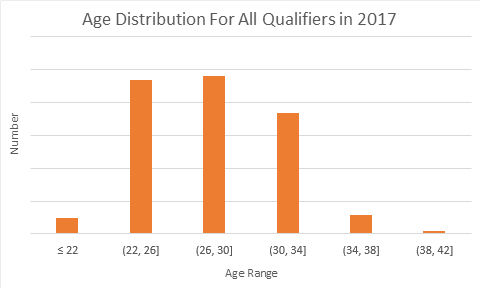

The first chart shows the age distribution for all players with at least 502 plate appearances in 2017 (qualifying players). We see that the largest distribution of players is from ages 26-30 with a significant drop off from age 30-34 and players over 34 barely represented at all. Baseball is truly a young man's game. However, when we look at those players who played all season and had a WAR less than 0, we see a much different distribution. In this case, the plurality of players are in the 30-34 age range with a larger share in the 34-42 age range. There are still a number of younger players, perhaps a few touted rookies or sophomores just getting in to the game. The main thing that the older players have in common is an extremely large paycheck.
Contracts in MLB are guaranteed, so a team will be paying a player whether he is playing or sitting. In some cases, a team is paying a player so much that they have no choice but to play them. Here is the salary distribution for players 30 or over with a negative WAR.

It is clear that teams are paying some of these players a great deal of money. The median salary for players over 30 with a negative WAR is $13.75 million. The median salary for all qualifiers in 2017 was only $5.3 million. This salary disparity may explain why teams will keep rolling out an over-paid player who isn't performing everyday. Call it buyers remorse, or just trying to give the fans somebody they want to see. The fact is, some of these players are pretty famous names. Here are the players who managed a negative WAR in the last 5 years making more than $20 million a year:

A few things jump out at this list. First, these are all players that were, at one time, considered superstars. Cabrera is a two time MVP, an 11 time All-Star, he has the first triple crown (winning Batting Title, Home Run Title, and RBI Title in the same year) in 45 years. He is a first ballot Hall of Famer by any reckoning. Albert Pujols has 2 World Series rings, 3 MVP awards, and 10 All-Star appearances. He also just got his 3000th hit. He is another shoe-in for the Hall. Ryan Howard has the ignominy of making this list twice. He would have made it three times, but he didn't have enough plate appearances in 2016. He is also a former MVP winner, a feared hitter, and has a World Series ring for the 2008 campaign. The others on this list are household names, at least to more than casual baseball fans.
So why did teams roll them out everyday? If you look to the right, you see that in all but two cases, the teams were well out of contention. Getting fans to the ballpark for a 64 win team is tough. Benching a guy who is eating one quarter of your salary, but is one of the most famous names in baseball might be tougher. In the two cases where teams were in contention, Hanley Ramirez and Carlos Gomez, both players were just slightly below replacement, though well below the level that you would expect from a player making over $20 million a year.
There is a lot more information in this dataset and I will return to it in a future post. As a coda, many of these players are still in the game. Howard is retired, but the others are still playing. Many have taken a step back, Reyes is now a utility infielder, others have taken a pay cut, Gonzalez and Reyes are now making in the $5 million range, while others continue in their futility, Chris Davis is likely to make the list again if he reaches at least 502 plate appearances. If you are a GM with a bad team, running out a once great player might at least put some people in the seats, so those players continue to trot out on the field everyday, when the team could improve just by bringing up somebody from AAA.
After 2016 and 2017, a new narrative has developed in baseball. A narrative that suggests that it is reasonable to "tank" a season in order to have a chance at future glory. The Cubs and Astros spent years in futility, collected a number of high draft picks, and then went on to become World Series Champions. FiveThirtyEight had an interesting article on why tanking might not be a good idea after all. However, a team that is tanking might well roll out a former super star everyday to try and get something for him. Maybe he gets on a streak and can be unloaded to an unsuspecting GM? However, in this age of data, the unsuspecting GM's are getting fewer and farther between.
Comments